The Supreme Court has ordered the constitution of a Special Investigation Team (SIT) under the supervision of the Uttar Pradesh Chief Secretary to probe the alleged fraudulent sale of lands belonging to the Spiritual Regeneration Movement Foundation of India, while setting aside an Allahabad High Court interim direction that had restrained police from filing a chargesheet in the case. A bench of Justice JK. Maheshwari and Justice Atul S. Chandurkar held that while a court may exercise discretion to protect an accused from coercive steps during pendency of proceedings, directing the investigating agency not to file a police report under Section 193(3) of the Bharatiya Nagarik Suraksha Sanhita (BNSS) was unjustified in the facts of the case. The case arose from an appeal filed by complainant Shrikant Ojha against an interim order passed by the Allahabad High Court in a criminal writ petition filed by one of the accused, Raghvendra Pratap Singh, a director of M/s Singhvahini Infraprojects Private Limited. The High Court had allowed investigation to continue in FIR No. 642 of 2025, registered at Noida Sector 39 Police Station, but restrained the investigating officer from submitting the police report till the writ petition was decided. According to the Supreme Court judgment, the dispute concerns the Spiritual Regeneration Movement Foundation of India, a society registered in 1963 under the Societies Registration Act. The Court noted allegations that various individuals had repeatedly sold society land in different states using forged documents and unauthorised claims to management control. Multiple civil and criminal proceedings are already pending in Delhi, Chhattisgarh, Uttar Pradesh and Madhya Pradesh over alleged fraudulent alienation of society property. The bench noted that despite earlier FIRs and ongoing litigation, properties were allegedly being continuously sold. “Even then they disposed the property of the society taking the law in their hand,” the Court observed while referring to allegations against the accused in the present FIR. The High Court had relied on prior judgments suggesting that disputes with a civil flavour may not always warrant criminal prosecution, and had also referred to the Supreme Court's ruling in *Pradnya Pranjal Kulkarni*. However, the apex court said that reliance was misplaced. The bench clarified that Pradnya Pranjal Kulkarni did not support a blanket stay on filing of a chargesheet. Rather, that judgment explained the distinction between the High Court's writ jurisdiction under Article 226 before cognisance is taken and its powers under statutory quashing jurisdiction thereafter. The Court also reiterated the principle laid down in Neeharika Infrastructure Pvt. Ltd. v. State of Maharashtra that blanket interim orders impeding investigation are generally impermissible without proper reasons. “From the reading of judgment of Pradnya Pranjal Kulkarni, we do not find any reason to direct stay on filing of the chargesheet,” the Court said, directing the investigating officer to complete the probe and file the report in the Noida FIR. Finding broader indications of organised land fraud, the Court decided to expand the scope beyond the immediate FIR. Referring to its earlier judgment in Pratibha Manchanda v. State of Haryana concerning land scams, the bench said such frauds undermine public trust and require unobstructed investigation. The Court accordingly directed constitution of an SIT under the supervision of the Uttar Pradesh Chief Secretary, with the Registrar of Societies as one of its members. The SIT has been tasked with identifying all lands belonging to the society, examining how properties were alienated or transferred without authorisation, and conducting a fact-finding inquiry into sales executed by persons other than the original office bearers. The SIT must submit its report to the police within three months, after which the relevant police authorities may take action if fraudulent conduct involving criminal intent is found. While granting interim protection from coercive action to respondent No. 2 until the SIT submits its report and investigation is completed, the Court directed all accused persons to cooperate fully. Significantly, the bench expressed concern about internal factional disputes within the society leading to dissipation of assets meant for public welfare. “After the death of its founder, it was not intended by him that the friction within groups shall lead to fights and the property which was quite valuable, shall be sold for their own interest contrary to the purpose and object,” the Court observed. Case : Shrikant Ojha v State of UP and others Citation : 2026 LiveLaw (SC) 493 Click here to read the judgment
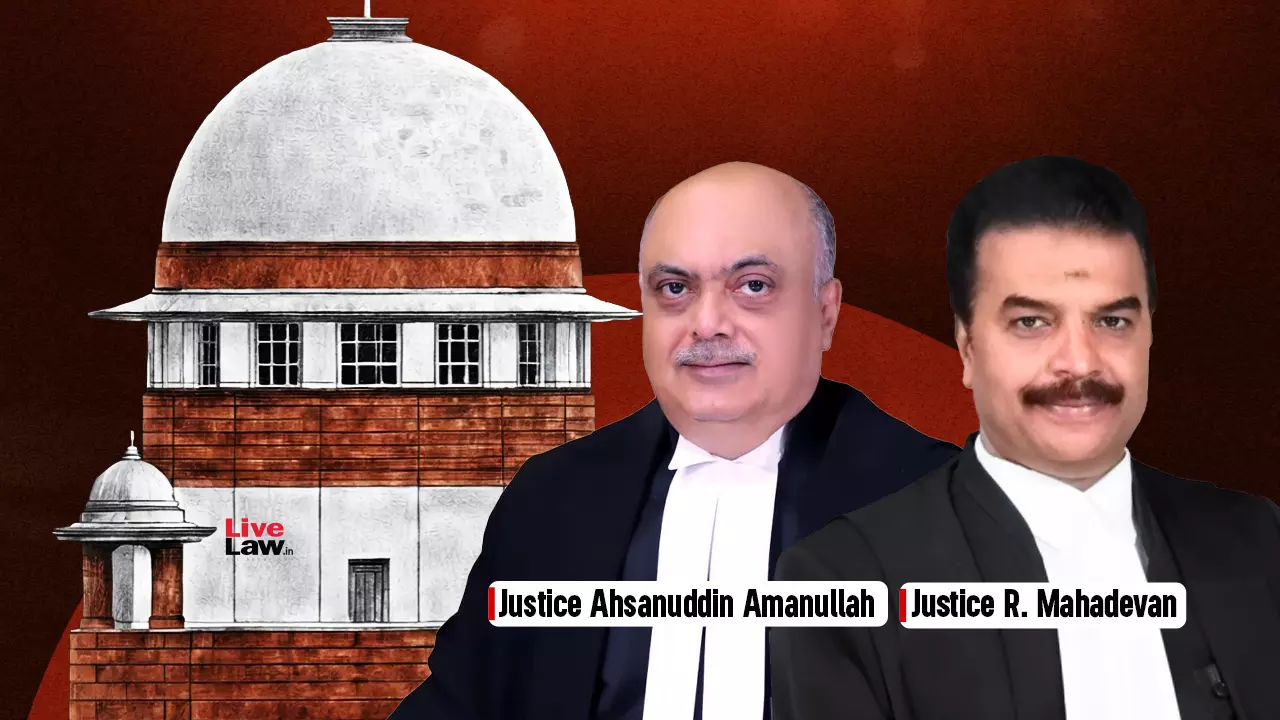
Today is the 15th day of arguments before the 9-judge bench of the Supreme Court in the Sabarimala reference. Apart from CJI Surya Kant, the Bench comprises Justice BV Nagarathna, Justice MM Sundresh, Justice Ahsanuddin Amanullah, Justice Aravind Kumar, Justice Augustine George Masih, Justice Prasanna B Varale, Justice R Mahadevan and Justice Joymalya Bagchi. Day 1 Report : Not Reviewing Sabarimala Verdict In Reference; Only Considering Constitutional Questions, Says Supreme Court 'There Can't Be Untouchability For 3 Days A Month', Justice Nagarathna On Article 17 Application In Sabarimala Case India Not Patriarchal Or Gender Stereotyped As The West Understands : Solicitor General To Supreme Court In Sabarimala Reference Reports from Day 2 Hearing are given below : How Can Non-Devotees Of Lord Ayyappa Challenge Sabarimala Custom? Supreme Court Asks Sabarimala Reference | Judicial Review Over Superstitious Practices Not Barred, Says Supreme Court In Hearing Sabarimala Reference | Centre Questions Verdicts Decriminalising Adultery & Homosexuality For Applying 'Constitutional Morality' Reports from Day 3 Hearing are given below : Excluding Other Denominations From Temples Will Affect Hinduism : Supreme Court In Sabarimala Reference Hearing Sampradayas Attached To Temple Must Be Followed While Visiting It: Supreme Court In Sabarimala Reference Hearing There Are Temples Where Only Women Can Go : Centre To Supreme Court In Sabarimala Reference Reports from Day 4 Hearing are given below : Difficult To Declare Belief Of Millions Wrong : Supreme Court In Sabarimala Reference Hearing Sabarimala Reference | Can't Hollow Out Religion In The Name Of Social Reform, Supreme Court Says In Hearing Sabarimala | Visit Of Fertile Women Antithetical To Deity's Identity; They Can Visit Other Ayyappa Temples : TDB To Supreme Court 'Constitutional Morality' In Religious Matters Like A Bull In A China Shop : Singhvi Tells Supreme Court In Sabarimala Reference Reports from Day 5 hearing : Women In South Avoid Temples During Menstruation As Matter Of Belief : Lawyer Tells Supreme Court In Sabarimala Reference Sabarimala Reference | Correct Test Is If Religious Belief Is Bona Fide, Not If It's Essential : Rajeev Dhavan To Supreme Court Day 6 hearing reports : Sabarimala Reference | If Believer Prevented From Touching Deity Only Due To Birth, Can't Constitution Intervene? Supreme Court Asks Sabarimala Reference | Supreme Court Debates Essential Religious Practice Test, Denominational Rights vs State Reform Power Day 7 hearing reports : Can't Lay Down Blanket Rules On State Interference In Religion For Social Reform : Supreme Court In Sabarimala Reference Hearing Sabarimala Reference | How Can Judgment Be Challenged In Writ? Supreme Court Questions Plea Against Dawoodi Bohra Practice Day 8 reports : Can't Take Information From 'WhatsApp University': Justice Nagarathna No Restriction On Women To Enter Mosque For Namaz; ERP Tests Wrongly Applied To Islam : AIMPLB Tells Supreme Court Day 9 reports : Sabarimala Reference | Art 25(2)(b) Mentions Throwing Open Of Only Temples Since Caste System Is Not In Other Religions : Justice Nagarathna 'Don't Argue Like This' : Supreme Court Rebukes Lawyer In Sabarimala Reference Hearing Day 10 reports : 'We Can't Be Part Of Annihilation Of Religion; Let's Not Open Age Old Customs' : Supreme Court In Sabarimala Reference Hearing Women Who Are True Devotees Of Lord Ayyappa Won't Go To Sabarimala Till They Attain 50 Years : Supreme Court 'Morality' Can't Be Interpreted As Societal Morality As It Can Be Based On Prejudices : Indira Jaising In Sabarimala Reference Day 11 reports : 'What Good Came Out Of Your PIL?' : Supreme Court Questions NGO Which Filed Plea For Sabarimala Women Entry 'How Can Right To Conscience Be Taken Away By Marriage?' : Supreme Court Questions Excommunication Of Parsi Women Marrying Outside Faith Day 12 reports : Constitution Didn't Intend To Give Religious Denomination Higher Rights Than Believer : Darius Khambata In Sabarimala Reference Day 13 Reports : What Happens To Indian Civilisation If Every Religious Practice Is Questioned In Courts? Supreme Court In Sabarimala Reference Female Genital Mutilation Affects Health; Can't Be Compared With Circumcision : Supreme Court In Sabarimala Reference Hearing SC Shouldn't Have Totally Struck Down Law Banning Excommunication : Supreme Court In Sabarimala Reference Hearing Day 14 Reports : Sabarimala Reference | Social Reform May Necessitate Scrutiny Of Religious Practices; Proportionality Test Can Be Used : Lawyers To Supreme Court Follow this page for today's live updates :
The Court ordered retrofitting of VLTDs and panic buttons in public service vehicles registered up to December 2018
The Supreme Court on Tuesday remarked that there is effectively “no concept of lane driving in India” as it dealt with a batch of matters concerning road safety compliance. A bench comprising Justice JB Pardiwala and Justice KV Viswanathan was hearing the matter S Rajaseekaran v. Union of India, in which the Court has been issuing directions from time to time for road safety. During the hearing, Justice Pardiwala commented, "How do you ensure in this country that drivers do not do away with lane driving? There is no concept of lane driving in this country. Most of the accidents occurs due to that." "Lane driving is something which will reduce the accidents considerably. Government must focus on it," Justice Pardiwala added, asking the Union to look into this aspect. Ensure transport vehicles have tracking devices On the issue of Vehicle Location Tracking Devices (VLTDs), the Court took note of submissions by the amicus curiae regarding Rule 125H of the Central Motor Vehicles Rules, 1989, which mandates installation of vehicle location tracking devices and emergency buttons in public service vehicles. The amicus highlighted the importance of the system in enabling timely emergency responses and improving passenger safety, particularly for women, children, and elderly persons. The Court recorded with concern that less than 1% of transport vehicles currently have the mandated tracking devices installed. Calling this situation disturbing, the Court directed all States and Union Territories to strictly enforce Rule 125H by ensuring installation of vehicle location tracking devices and panic buttons in both new and existing public service vehicles in a time-bound and verifiable manner. The Court further ordered that no public service vehicle should be granted a fitness certificate under Section 56 or a permit under Section 66 of the Motor Vehicles Act unless installation of such devices is verified and reflected in the Vahan application. It also directed retrofitting of these devices in vehicles registered up to December 21, 2018, and integration of compliance monitoring with the Vahan database for real-time oversight. When it was suggested that manufacturers themselves should pre-fit these devices in vehicles, the Court welcomed the proposal and directed the Union Government to engage with automobile manufacturers across the country and place an appropriate report before the Court. On speed-limiting devices, the Court took serious note of the failure of most States to file compliance reports despite earlier directions concerning Rule 118 of the Central Motor Vehicles Rules. It reiterated that manufacturers are obligated to fit speed limiting devices and directed State governments to submit fresh comprehensive affidavits supported by Vahan and Parivahan portal statistics. The Court also expressed displeasure over the continued non-constitution of the National Road Safety Board, observing that despite six months having been granted on May 4, 2025, the Board remains unconstituted. Granting what it termed a final opportunity, the Court directed that the Board be constituted within three months. In relation to the Uttar Pradesh legislation under which prosecutions under the Motor Vehicles Act stood abated before a cut-off date, the Court noted the State's April 8, 2026 ordinance seeking revival of previously abated non-compoundable cases. Observing that the issue required further deliberation, the Court directed the State to provide details on how many cases would be revived and the mechanism for doing so.
He argued that an interpretation allowing the clergy to overpower individual conscience must be shunned.
The Supreme Court on Wednesday stayed the Madras High Court's order, which stopped TVK MLA Sreenivasa Sethupathi from voting in the Tamil Nadu Assembly floor test. The Court also stayed the proceedings in the Madras High Court in the writ petition filed by DMK candidate KR Periakaruppan challenging Sethupathi's win. A bench of Justice Vikram Nath, Justice Sandeep Mehta and Justice Vijay Bishnoi heard the plea filed by TVK MLA Sreenivasa Sethupathi challenging the Madras High Court order restraining him from participating in the floor test scheduled for today in the Tamil Nadu Assembly. Senior Advocate Dr Abhishek Manu Singhvi submitted that the High Court's judgment is so erroneous that some strictures should be passed. Singhvi expressed surprise at the writ petition, filed on a Saturday evening, being urgently heard on Sunday. The bench asked Senior Advocate Mukul Rohatgi, appearing for DMK candidate Periakaruppan, how a writ petition under Article 226 could be filed against the election result. The bench pointed out that the Election Petition is the correct remedy. "This is atrocious. The High Court says remedy is election petition and still entertains the writ petition," Justice Mehta said. Rohatgi said that the extraordinary facts of the case warranted the exercise of the extraordinary jurisdiction. He stated that his client contested from constituency no.185 (Thirpathhur) and there was another constituency with the same name, constituency no.50. A postal ballot in favour of Periakaruppan was mistakenly delivered to constituency no.50. Had that postal ballot been counted, the result would be a tie, Rohatgi stated. The senior counsel contended that it was an unprecedented case. The bench, giving opportunity to Rohatgi to file a counter-affidavit, stayed the High Court's order. Singhvi submitted that the floor test proceedings are underway. Rohatgi said that DMK was walking out of the floor test, and the petitioner's participation may not be consequential. Singhvi had mentioned the matter yesterday before Chief Justice of India Surya Kant, seeking urgent listing in view of the imminent floor test. Taking note of the urgency, the CJI agreed to list the matter on Wednesday. The controversy arises after the Madras High Court, in an order passed yesterday, barred Sethupathi from voting in the trust vote. Sethupathi had defeated DMK leader Periakaruppan by a margin of a single vote in the election. The DMK candidate filed a writ petition, contending that a postal ballot, which was in his favour, was not considered, as it was wrongly sent to another constituency. The High Court passed the interim order observing that if Sethupathi was allowed to vote when the dispute is pending, it may affect the government itself. The High Court therefore observed that the balance of convenience was in favour of stopping his vote. Appearance: For R. Sreenivasa Sethupathi: Dr. Abhishek Manu Singhvi, Sr. Adv. Ms. Rupali Francesca Samuel, Adv. Ms. Dixita Gohil, Adv. Mr. Yash S. Vijay, AOR Mr. Pranjal Agarwal, Adv. Ms. Priyansha Sharma, Adv. Mr. T Mahendran, Adv. Mr. Shikhar Aggarwal, Adv. Mr. Joshua Tom Thomas, Adv. Ms. Aditi Soni, Adv. For KR. Periakaruppan: Mr. Mukul Rohatgi, Sr. Adv. Mr. Nr Elango, Sr. Adv. Ms. Devyani Gupta, AOR Mr. Muthu Thangathurai, Adv. Ms. Tanvi Anand, Adv. Mr. Agilesh Kumar S, Adv. Mr. Aswin Prasanna As, Adv. Mr. Pranjal Mishra, Adv. Ms. Sommya Kashyap, Adv. For Election Commission of India: Mr. Dama Seshadri Naidu, Sr. Adv. Mr. Prateek Kumar, Adv. Mr. Devansh Rai, Adv. Mr. Abhinav Thakur, Adv. Ms. Simran Parmar, Adv. Ms. Ananya Mishra, Adv. Case: R SREENIVASA SETHUPATHI Vs. KR PERIAKARUPPAN ORS with Diary No. 29435 / 2026
Service Law - Supreme Court Quarterly Digest Jan - Mar, 2026 Accelerated Promotion – Counter-Extremism/Naxal Activities – Parity in Treatment – Judicial Review of Committee Decisions – The Supreme Court upheld the High Court's direction to grant accelerated promotion to a police constable (Respondent) who resisted a Naxalite attack on a police station - The State had denied the promotion claiming the Respondent's role was "nominal" compared to a colleague (G. Venkat Reddy) who received the benefit – Supreme Court found the Committee's assessment "perverse" as it was admitted that the Respondent, while on roof-top guard sentry duty, fired more rounds at the Naxalites than the promoted colleague and was instrumental in repelling the attack - Held, when collective efforts repel an attack, it is unfair to belittle the role of individual personnel to deny them benefits intended to boost the morale of the force - While the Court's intervention in decisions taken by specialized Committees for out-of-turn promotion is minimal, such decisions are not immune to interference if they are found to be unfair or based on perverse findings – Appeal dismissed. [Relied on State of Madhya Pradesh & Anr. vs. Sanjay Shukla (Civil Appeal No. 2040 of 2023, decided on March 27, 2023; Paras 9, 10] State of Telangana v. P. Srinivas, 2026 LiveLaw (SC) 263 : 2026 INSC 258 Allocation of Cadre – Indian Police Service (IPS) – Request for re-allocation to 'insider' vacancy – Finality of Selection – The Supreme Court dismissed the appeals of an IPS officer seeking re-allocation from the Tamil Nadu cadre to an 'insider' vacancy in the Rajasthan cadre from the 2004 examination batch - held that cadre allocation cannot remain fluid indefinitely, as it would lead to a "chain reaction" of reshuffling among selected candidates from the same batch – Noted that the appellant, who was third in the merit list for the 'insider' vacancy, raised his grievance in 2010, six years after the selection process - noted that the appellant had already served in the Tamil Nadu cadre for over two decades by the time of the final hearing. Rupesh Kumar Meena v. Union of India, 2026 LiveLaw (SC) 122 : 2026 INSC 119 : AIR 2026 SC 900 Allotment of Housing – Eligibility Criteria – Nepotism and Self-Aggrandizement – Supreme Court set aside the allotment of super deluxe flats to a Governing Body member (Respondent No. 3) and his subordinate (Respondent No. 4) – i. Ineligibility of Respondent No. 3: The allotment was deemed a "blatant display of self-aggrandizement" as the respondent did not satisfy the mandatory six-month deputation period at the time of application and had not submitted a timely application or earnest money deposit (Para 13, 14); ii. Ineligibility of Respondent No. 4: The Court found that Respondent No. 4 did not fall within the stipulated pay-band level (Level 10 to 20) and that the Governing Body's decision to "regularize" the allotment by carving out an exception was an arbitrary exercise of power. [Paras 15, 16] Dinesh Kumar v. State of Haryana, 2026 LiveLaw (SC) 171 : 2026 INSC 163 : AIR 2026 SC 1495 Appointment of Director General of Police (DGP) – Role of UPSC and State Government – Delay in submitting proposals – Selection Guidelines – i. Mandate for Regular Appointment: The Supreme Court reiterated the necessity of appointing a regular Director General of Police (Head of Police Force) in accordance with the time-frame and scheme established in Prakash Singh vs. Union of India, (2006) 8 SCC 1; ii. Obligation of UPSC: Despite inordinate delays by State Governments in submitting proposals, the UPSC is obligated to convene the Empanelment Committee Meeting (ECM) to prevent further aggravation of the situation and to ensure meritorious senior officers are not overlooked; iii. Ad hoc Arrangements Criticized: The Supreme Court expressed concern over States preferring ad hoc arrangements (appointing acting DGPs) instead of regular appointments, which led to the UPSC inserting paragraph 4(xii) into its guidelines requiring States to seek leave from the Supreme Court for delayed submissions; iv. Enforcement Mechanism: To ensure compliance with the Prakash Singh mandate, the UPSC is authorized to: a. Write to State Governments for timely proposals whenever a vacancy arises; b. Move an application before the Supreme Court for enforcement if a State fails to submit a timely proposal; v. Accountability: held that those responsible for the delay in submitting proposals shall be held accountable. [Paras 7-11] Union Public Service Commission v. T. Dhangopal Rao, 2026 LiveLaw (SC) 144 Appointment of Vice-Chancellor – Conflict between State/UT Act and UGC Regulations – Legislative Competence – Doctrine of Repugnancy - The Supreme Court affirmed the High Court's decision to strike down Section 14(5) of the Puducherry Technological University Act, 2019 (PTU Act) for being inconsistent with Regulation 7.3 of the UGC Regulations, 2018 - held that since UGC Regulations trace their source to Entry 66 of List I (Union List), they possess an overriding effect over State/UT legislations enacted under Entry 25 of List III (Concurrent List) - The Search-cum-Selection Committee for a Vice-Chancellor must necessarily include a nominee of the Chairman, UGC, and its members must not be connected with the University - Key Legal Issues & Rulings – i. Primacy of Entry 66 List I over Entry 25 List III - Supreme Court reiterated that while both the Union and States can legislate on "Education" under Entry 25 of List III, such power is expressly subject to Entry 66 of List I (Coordination and determination of standards) - Any State legislation that impinges upon or dilutes the standards prescribed by the Union under Entry 66 is ultra vires; ii. Mandatory Nature of UGC Regulations - Regulation 7.3 of the UGC Regulations, 2018, which mandates the inclusion of a UGC nominee in the Search-cum-Selection Committee, is an integral component of "standards in higher education." - Section 14(5) of the PTU Act, which omitted this requirement and included a government official (Pro-Chancellor) in the committee, was declared invalid; iii. Doctrine of Repugnancy and Article 254(2) - noted that the doctrine of repugnancy under Article 254 and the need for Presidential assent apply only when both Central and State legislations operate within the Concurrent List - Since the UGC Act and Regulations are referable to List I (Entry 66), the question of curing repugnancy via Article 254(2) does not arise; iv. Exercise of Article 142 Powers - Despite finding the appointment procedure illegal, Supreme Court invoked its extraordinary powers under Article 142 to allow the appellant to complete his tenure (ending December 2026) - This was done to avoid "grave stigma" to the academician and administrative disruption, noting there were no allegations against the appellant's integrity or merit. [Relied on Hoechst Pharmaceuticals Ltd. v. State of Bihar (1983) 4 SCC 45; Gambhirdhan K. Gadhvi v. State of Gujarat (2022) 5 SCC 179; Paras 37-43, 46-48, 51-52] Dr. S. Mohan v. Puducherry Technological University, 2026 LiveLaw (SC) 96 : 2026 INSC 100 : AIR 2026 SC 730 Border Security Force Act, 1968; Section 40, 48(1)(c) and 50 — Dismissal from Service — National Security — Proportionality of Punishment — The Supreme Court upheld the dismissal of a BSF Sub-Inspector with 36 years of service who was convicted of facilitating illegal cattle smuggling at the Indo-Bangladesh border - Noted that when national security is paramount, infractions by officers manning the borders cannot be viewed lightly - held that under Section 50 of the BSF Act, 1968, a Security Force Court is permitted to impose a composite sentence, including both imprisonment and dismissal, as contemplated under Section 48(1)(c). Bhagirath Choudhary v. Border Security Force, 2026 LiveLaw (SC) 165 Character and Suitability for Disciplined Force – Held that a candidate for the police force must possess impeccable character, rectitude, and integrity - The employer, through a screening committee, has a wide realm of discretion to assess the suitability of a candidate based on their criminal antecedents, even if an acquittal has been recorded - An acquittal based on technical grounds or "benefit of doubt" does not automatically entitle a candidate to appointment. State of Madhya Pradesh v. Rajkumar Yadav, 2026 LiveLaw (SC) 234 : 2026 INSC 225 : AIR 2026 SC 1471 Constitution of India - Article 14 – Discrimination – noted that the respondents failed to show that any similarly situated candidates (those admitted after the 2010-11 session) were given direct appointments - noted that the last direct appointments (made in 2015) were pursuant to Court orders and limited to batches admitted prior to the 2011 policy change - Noted that the Uttar Pradesh Ayush Department (Ayurved) Nursing Service Rules, 2021 now govern the post, and recruitment must be conducted through the UPSSSC to select the most meritorious candidates. [Relied on Sivanandan C T and Others vs. High Court of Kerala and Others (2023 INSC 709; Paras 19-27] State of Uttar Pradesh v. Bhawana Mishra, 2026 LiveLaw (SC) 26 : 2026 INSC 38 Constitution of India - Articles 14 and 16 - Retrospective Application of Recruitment Rules — Change in the "Rules of the Game" — The Supreme Court set aside the retrospective application of the Bihar Engineering Service Class-II Recruitment (Amendment) Rules, 2022, which introduced a 25% weightage for contractual work experience after the selection process (written examination and provisional merit list) had already commenced under the 2019 Rules – Supreme Court laid down key legal principles – i. Recruitment Process Sanctity: Eligibility criteria notified at the start of a recruitment process cannot be changed midway unless the extant rules or the advertisement explicitly permit such changes; ii. Vested Rights vs. Selection Criteria: While the State has the power to legislate retrospectively under Article 309, this power cannot be used to arbitrarily disrupt a selection process or alter the "eligibility criteria for being placed in the merit list" once the "game" has already been played; iii. Executive Instructions vs. Statutory Rules: The State cannot rely on executive memos (2018 and 2021) to override statutory recruitment rules that were in force at the time of the advertisement, particularly to the detriment of candidates who had no prior notice of such weightage - Supreme Court directed the State to finalize appointments based on the original merit lists from June/July 2022, strictly following the unamended 2019 Rules, within two months. [Relied on Tej Prakash Pathak and Others v. Rajasthan High Court and Others, (2025) 2 SCC 1; K. Manjusree v. State of Andhra Pradesh & Anr., (2008) 3 SCC 512; Paras 25-45] Abhay Kumar Patel v. State of Bihar, 2026 LiveLaw (SC) 14 : 2026 INSC 24 Constitution of India - Article 14 and 16 — Regularization of Service — Model Employer — The Supreme Court set aside the Jharkhand High Court's refusal to regularize contractual employees who had served for over a decade in sanctioned posts - held that the State, as a "model employer," cannot exploit the unequal bargaining power of employees by keeping them in perpetual contractual roles to evade regular employment obligations - Abruptly discontinuing long-serving employees solely based on "contractual nomenclature" without a speaking order is manifestly arbitrary and violative of Article 14. Bhola Nath v. State of Jharkhand, 2026 LiveLaw (SC) 95 : 2026 INSC 99 Constitution of India - Article 16 – Recruitment Process – Challenge by Unsuccessful Candidate – Estoppel – All India Council for Technical Education (Career Advancement Scheme for the Teachers and Other Academic Staff in Technical Institutions) (Degree) Regulations, 2012 – Scope and Applicability – Direct Recruitment vs. Career Progression - Held that it is a settled principle that a candidate who participated in the selection process without protest cannot challenge the "rules of the game" after being declared unsuccessful – Noted that the respondent participated in the interview held on 17.12.2015, secured 28 marks against the qualifying 45, and only challenged the process after failing to secure a recommendation – Held that to apply AICTE Regulations to a candidate participating in recruitment for the post of Professors in the Engineering Colleges in the State conducted by the Commission under State Rules framed by the State, would be to stretch the AICTE Regulations beyond its text, context, and purpose - The law does not permit a regulation crafted as a ladder to be used as a gate – Held that the AICTE Regulations do not apply to the process of direct recruitment under the State Rules - The AICTE Regulations of 2012 are not "Recruitment Rules" but are "Promotion and Progression Rules" - They apply to individuals already within the institutional framework (incumbents or newly appointed staff) for the purpose of career advancement - Suitability for a post determined by a committee of experts does not warrant interference in the exercise of powers of judicial review – Appeal allowed. [Relied on Anupal Singh & Others v. State of Uttar Pradesh, (2020) 2 SCC 173; Paras 13 – 18] Gujarat Public Service Commission v. Gnaneshwary Dushyantkumar Shah, 2026 LiveLaw (SC) 64 : 2026 INSC 70 Constitution of India - Article 32, 19(1)(d), 19(1)(e), and 19(1)(g) – Judicial Service – Migration to another State Service – Right to Profession – Petitioners, serving as Civil Judges in Uttarakhand, sought permission to join the Delhi Judicial Service after being declared successful in the recruitment examination - The High Court of Uttarakhand rejected their request, citing concerns over judicial vacancies and the impact on the litigant public - Held: The interest of the individual officers to advance their careers has an overriding effect over the administrative concerns of the parent High Court regarding vacancies - Denial of such permission results in "negativity, frustration," and a violation of fundamental rights guaranteed under the Constitution - The Supreme Court directed the High Court of Uttarakhand to pass orders for the cessation of their services to enable them to join the Delhi Judicial Service by the stipulated deadline - Supreme Court clarified that while the petitioners' joining was delayed due to the pending legal challenge, their seniority in the Delhi Judicial Service must be maintained as per their original position in the Select List - held that permission cannot be denied to a judicial officer to join the service of another State merely on the ground that migration will give rise to vacancies in the first State - The delay caused by the litigation shall not adversely affect their merit-based seniority – Petition allowed. [Paras 13-18] Anubhuti Goel v. High Court of Uttarakhand, 2026 LiveLaw (SC) 67 Constitution of India - Article 32 – Writ Jurisdiction – Principles of Natural Justice – Doctrine of Bias – Selection Process – Search-cum-Selection Committee (SCSC) – Bias and Malafides in Service Matters - The Supreme Court allowed the writ petition, setting aside the SCSC's decision to reject the petitioner's candidature - held that the inclusion of an officer as a member of the selection committee who had been personally arraigned as a contemnor by the candidate in the same dispute violates the principles of natural justice - Such participation creates a "reasonable apprehension of bias" in the mind of the candidate, rendering the decision-making process vulnerable and a nullity, regardless of whether actual bias is proven – Noted that justice must not only be done but must manifestly be seen to be done, and authorities must appear to act fairly to preserve public confidence in the impartiality of the selection process – Supreme Court directed the DoPT to convene a fresh SCSC meeting within four weeks, excluding "the Officer" in question, and imposed costs of Rs. 5 lakhs on the respondents for "rank procrastination" and "deliberate obstacles" bordering on vendetta. [Relied on State of Gujarat v. R.A. Mehta, (2013) 3 SCC 1; A.K. Kraipak v. Union of India, (1969) 2 SCC 262; S. Parthasarathi v. State of A.P., (1974) 3 SCC 459; Paras 41-46] Captain Pramod Kumar Bajaj v. Union of India, 2026 LiveLaw (SC) 97 : 2026 INSC 101 Constitution of India - Article 136 — Scope of Interference — Contract Law — Unconscionable Agreements — "Lion and Lamb" Analogy - While the Court is cautious with concurrent findings, it can interfere under Article 136 if findings are perverse, disregard statutory provisions, or result in substantial and grave injustice – Noted that an appellant must demonstrate exceptional circumstances for such review - Where a "mighty" State (the lion) contracts with an individual job seeker (the lamb), the inequality is structural - Clauses barring claims for regularization in such standard-form contracts are unconscionable if the employee had no meaningful choice but to "sign on the dotted line." - Acceptance of such terms does not amount to a waiver of fundamental rights - Continuous service for over a decade, supported by repeated extensions and satisfactory performance, nurtures a legitimate expectation of recognition - The bar against this doctrine for contractual workers only applies if the initial appointment lacked a proper selection process - directed the respondent-State to forthwith regularize the services of all the appellants against the sanctioned posts to which they were initially appointed - The appellants shall be entitled to all consequential service benefits accruing from the date of this judgment. [Relied on State of Karnataka v. Umadevi (2006) 4 SCC 1; Central Inland Water Transport Corpn. v. Brojo Nath Ganguly (1986) 3 SCC 156; Chandra Singh v. State of Rajasthan (2003) 6 SCC 545; Army Welfare Education Society v. Sunil Kumar Sharma (2024) 16 SCC 598; Jaggo v. Union of India, 2024 SCC OnLine SC 3826; State of Karnataka v. Uma Devi, (2006) 4 SCC 1; Paras 11-14] Bhola Nath v. State of Jharkhand, 2026 LiveLaw (SC) 95 : 2026 INSC 99 Constitution of India - Article 142 – Gender Equality in Armed Forces – Grant of Permanent Commission (PC) to Short Service Commission Women Officers (SSCWOs) – Assessment of Merit – Casual Grading of ACRs – The Supreme Court held that the Annual Confidential Reports (ACRs) of women officers commissioned between 2010 and 2012 were authored under the systemic assumption that they were ineligible for career progression beyond 14 years - This institutional mindset resulted in "middling" or "average" grades being assigned to women while "outstanding" grades were reserved for male counterparts whose future depended on them - Supreme Court observed that such a structural disadvantage, embedded in years of service assessments, cannot be neutralized by mere procedural safeguards like anonymization of data at the final evaluation stage. Lt Col Pooja Pal v. Union of India, 2026 LiveLaw (SC) 283 : 2026 INSC 281 Constitution of India - Article 233(2) – Eligibility of Judicial Officers for District Judge Recruitment – Direct Recruitment vs. Promotion – Practice Requirement - Held: In-service judicial officers are eligible for appointment as District Judges through direct recruitment - Their past service as a judicial officer must be counted toward the minimum practice requirement of seven years as stipulated under Article 233(2) - Categories of Relief held – i. Category A (Appointed but Reverted): Officers whose appointments were reversed due to an erroneous interpretation of law are deemed to have continued in service without a break - They are entitled to seniority and notional pay fixation but no arrears of pay; ii. Category B (Selected but not Formally Appointed): Selected candidates whose appointments were stalled by judicial intervention must be immediately offered appointments, subject to vacancy availability. Seniority will be determined by a committee of three senior High Court judges; iii. Category C & D (Ongoing or Future Selection): Officers currently in the selection process or seeking to participate must be treated as eligible; iv. Age Relaxation: Candidates who crossed the age limit while erroneously considered ineligible are granted a one-time relaxation to participate in the next selection process; v. Cadre Management: All officers benefiting from these directions shall be treated as District Judges appointed through direct recruitment. [Overruled Dheeraj Mor v. High Court of Delhi, (2020) 7 SCC 401; Paras 5-22] Rejanish K.V. v. K. Deepa, 2026 LiveLaw (SC) 306 Constitution of India - Article 309 – Bihar Pharmacists Cadre Rules, 2014 (as amended in 2024) – Rule 6(1) – Validity of Minimum Qualification – The Supreme Court upheld the constitutional validity of Rule 6(1) and the "Note" in Appendix-I of the Cadre Rules, which prescribes Diploma in Pharmacy as the essential qualification for the post of Pharmacist (basic category) - Noted that candidates possessing higher qualifications (B. Pharma/M. Pharma) are eligible only if they also possess a Diploma in Pharmacy as the essential qualification for the post of Pharmacist (basic category) - Noted that candidates possessing higher qualifications (B. Pharma/M. Pharma) are eligible only if they also possess a Diploma in Pharmacy - It is the exclusive prerogative of the State, as an employer, to determine the most suitable qualifications for public posts based on its independent assessment - The power of judicial review is limited and cannot be used to rewrite service rules, determine equivalence of qualifications, or substitute the Court's assessment for that of the employer – Appeal dismissed. MD. Firoz Mansuri v. State of Bihar, 2026 LiveLaw (SC) 57 : 2026 INSC 68 Constitution of India - Article 311(2)(b) – Dismissal from service without departmental inquiry – Scope of "Reasonably Practicable" – Requirement of Objective Satisfaction – The Supreme Court set aside the dismissal of a Delhi Police Constable, holding that the power to dispense with a regular departmental inquiry under Article 311(2)(b) cannot be exercised based on mere "assumptions and conjectures" - Supreme Court noted that the disciplinary authority must record satisfaction based on independent material showing that holding an inquiry is not "reasonably practicable" - Key Observations held – i. Judicial Review and Satisfaction - The finality given to the disciplinary authority's decision under Article 311(3) is not binding on the Courts - The scope of judicial review is open to strike down orders dispensing with an inquiry if the reasons are irrelevant, arbitrary, or lack a factual basis – Held that court must consider whether a "reasonable man acting in a reasonable way" would have reached the same conclusion in the prevailing situation; ii. Absence of Material Evidence: In the present case, the Preliminary Inquiry (PE) report failed to record any specific instances of the appellant who was in custody at the time—threatening or intimidating witnesses - The Deputy Commissioner of Police (DCP) relied on the ACP's "presumption" of potential witness tampering without any supporting material, which the Court deemed a failure of application of mind; iii. Custody as a Factor: It was incumbent upon the authority to demonstrate how the appellant, while in jail, posed a threat that made an inquiry "not reasonably practicable"; iv. Adherence to Circulars: noted that the Delhi Police's own circulars (dated 31.12.1998 and 11.09.2007) mandate that Article 311(2)(b) should not be used as a "short cut" and requires "cogent and legally tenable reasons". [Relied on Union of India v. Tulsiram Patel (1985) 3 SCC 398; Jaswant Singh v. State of Punjab (1991) 1 SCC 36; Paras 23-40] Manohar Lal v. Commissioner of Police, 2026 LiveLaw (SC) 236 : 2026 INSC 234 Consumption of Vacancy – Supreme Court observed that even if a senior candidate (Rishikesh Meena or Rajesh Kumar) does not join or accept an 'insider' vacancy, the next candidate in the merit list does not gain an automatic right to claim allocation to that specific post - Finality must be attached to the selection and allocation process to prevent administrative instability – Appeals dismissed. [Paras 9-12] Rupesh Kumar Meena v. Union of India, 2026 LiveLaw (SC) 122 : 2026 INSC 119 : AIR 2026 SC 900 Contractual Employment through Third-Party Contractor vs. Direct Contractual Employment – Claim for Minimum Time Scale of Pay – Distinction in Law – The Supreme Court set aside a High Court order directing the Municipal Council to pay the minimum time scale of pay to workers engaged through third-party contractors - held that a valid distinction exists between persons employed directly by a State entity and those engaged through an intermediary contractor - While regular employment involves transparent, merit-based procedures open to all citizens, contractors have absolute discretion in selecting personnel to be sent to the principal employer - Granting equal benefits and status to contractor-engaged workers would sanction an arbitrary recruitment process and bypass constitutional safeguards for public employment. [Relied on Bharat Heavy Electricals Limited vs. Mahendra Prasad Jakhmola and others, (2019) 13 SCC 82; Joint Secretary, Central Board of Secondary Education and Another Vs. Raj Kumar Mishra and Another, Civil Appeal No. 4014 of 2025; Paras 8-11] Municipal Council v. K. Jayaram, 2026 LiveLaw (SC) 38 Dearness Allowance (DA) — Legally Enforceable Right — Financial Inability of State — The Supreme Court held that the right to receive Dearness Allowance is a legally enforceable right that accrued in favor of the employees of the State of West Bengal – Held that while the State has the discretion to formulate its pay structure, once it incorporates a specific standard (like the All-India Consumer Price Index - AICPI) into its statutory rules (ROPA Rules, 2009), it cannot deviate from that mechanism through executive memoranda. State of West Bengal v. Confederation of State Government Employees, 2026 LiveLaw (SC) 120 : 2026 INSC 123 : AIR 2026 SC 1213 Departmental Enquiry – Post-Superannuation – Lack of Jurisdiction – Adoption of Rules – The Supreme Court quashed a departmental enquiry initiated against a retired employee of the Maharashtra State Warehousing Corporation (MSWC) approximately 11 months after his superannuation - Held that in the absence of specific provisions in the Maharashtra State Warehousing Corporation (Staff) Service Regulations, 1992, the Corporation could not ipso facto apply the Maharashtra Civil Services (Pension) Rules, 1982, to initiate proceedings against a retired employee without a conscious decision or resolution by the Board of Directors to adopt such rules - that a public-sector corporation cannot initiate or continue disciplinary proceedings against an employee after retirement in the absence of an express enabling provision in its service regulations. Kadirkhan Ahmedkhan Pathan v. Maharashtra State Warehousing Corporation, 2026 LiveLaw (SC) 10 : 2026 INSC 16 Departmental Inquiry — Proof of Misconduct — Fabrication of Medical Certificate — Graver the charge, greater the need for caution and circumspection — Findings of Inquiry Officer based on "word against word" without expert verification held perverse — Where a charge of forgery entails mandatory dismissal, fair play requires a thorough investigation consistent with principles of natural justice – Facts - The appellant, a Court Attender, was dismissed from service on charges of unauthorized absence and submitting a fabricated medical certificate. The Inquiry Officer relied on the statement of a Medical Practitioner (PW-2) who denied issuing the certificate, despite admitting the appellant consulted him and that the letterhead belonged to him - The High Court upheld the dismissal - Supreme Court Findings – i. Perversity in Findings: The Supreme Court held that the Inquiry Officer's conclusion was perverse as it was based on no credible evidence - noted that the rubber stamp on the disputed certificate was identical to the one used by the doctor on official notices; ii. Need for Handwriting Expert: Since the certificate was fully handwritten and the doctor's undisputed signatures varied, the Inquiry Officer should have referred the matter to a handwriting expert before recording a finding of forgery; iii. Standard of Proof for Grave Charges: When charges involve consequences like loss of livelihood, investigations must be consistent with the requirement of the situation and fair play. [Relied on Sawai Singh vs. State of Rajasthan (1986) 3 SCC 454; Paras 31-45] K. Rajaiah v. High Court for the State of Telangana, 2026 LiveLaw (SC) 140 : 2026 INSC 142 : AIR 2026 SC 890 Disciplinary Inquiry – Principles of Natural Justice – The appellant alleged a gross breach of natural justice, claiming the inquiry officer abruptly closed proceedings on August 1, 2017, preventing the completion of cross-examination of management witnesses - The High Court erred by not considering these allegations of procedural lapses and the merits of the Tribunal's original findings while ordering a remand. Hemlata Eknath Pise v. Shubham Bahu Uddeshiya Sanstha Waddhamna, 2026 LiveLaw (SC) 177 : 2026 INSC 147 Disciplinary Proceedings against Judicial Officers – Removal from service based solely on judicial orders – Permissibility – Appellant, a judicial officer with 27 years of unblemished service, was removed for granting bail in four cases under the M.P. Excise Act without expressly mentioning the "twin conditions" of Section 59-A - Held: Merely because a judicial order is wrong, erroneous, or fails to refer to a statutory provision, it cannot be the basis for disciplinary action unless there is evidence of corrupt motive or extraneous consideration - The High Court must exercise great caution and protect honest officers from unmerited onslaughts based on motivated complaints. Order of removal set aside with full back wages. Nirbhay Singh Suliya v. State of Madhya Pradesh, 2026 LiveLaw (SC) 2 : 2026 INSC 7 Disciplinary Proceedings – Continuance after Superannuation – Permissibility of Punishment – Punjab and Sind Bank Officers' Service Regulations, 1982; Regulation 20(3)(iii) – Punjab and Sind Bank Employees' Pension Regulations, 1995; Regulation 48 - The Supreme Court upheld the dismissal of a writ petition filed by a retired bank officer challenging a punishment of "reduction by three stages in the time scale of pay" imposed after his superannuation - Key Findings by Supreme Court – i. Continuance of Proceedings: If service rules permit, disciplinary proceedings initiated before superannuation can be continued and brought to a logical conclusion even after the employee attains the age of superannuation; ii. Legal Fiction of Service - Regulation 20(3)(iii) of the Service Regulations creates a legal fiction where the officer is deemed to be in service until the proceedings are concluded; iii. Implementability of Punishment - The Court rejected the argument that only penalties under Pension Regulations could be imposed post-retirement - held that a punishment of reduction in pay scale relates back to the date of superannuation and is implementable because pension is computed based on the salary last drawn/payable; iv. Misconduct by Bank Officers: A bank officer holds a position of trust - Failure to ensure the end-use of a loan constitutes a financial irregularity that exposes the bank to risk and amounts to misconduct, regardless of whether an actual loss was suffered. [Relied on Chairman-cum-Managing Director, Mahanadi Coalfields Ltd. vs. Rabindranath Choubey (2020) 18 SCC 71; Ramesh Chandra Sharma vs. Punjab National Bank and Another (2007) 9 SCC 15; State Bank of India vs. Ram Lal Bhaskar (2011) 10 SCC 249; Paras 25-37] Virinder Pal Singh v. Punjab and Sind Bank, 2026 LiveLaw (SC) 268 : 2026 INSC 266 Distinction between "Honourable Acquittal" and "Acquittal on Benefit of Doubt" – An honourable acquittal occurs when the court definitively concludes that the accused did not commit the offence - In contrast, an acquittal based on a "benefit of doubt" due to a weak prosecution case or lack of credible evidence is a technical consideration and does not constitute a "clean chit". [Para 5] State of Madhya Pradesh v. Rajkumar Yadav, 2026 LiveLaw (SC) 234 : 2026 INSC 225 : AIR 2026 SC 1471 Drugs and Cosmetics Rules, 1945 – Directions issued by the Court – i. Selection Criteria - Public Service Commissions (HPSC and KPSC) must complete selections based strictly on educational qualifications in Rule 49, ignoring the "experience" requirement added by State Rules; ii. Redrawing Merit List - Lists must be redrawn within eight weeks; iii. Protection of Existing Appointees (Haryana) - Selected candidates who remain in the new merit list shall continue in service - Those who fall out of the merit list may be continued only at the State's discretion via supernumerary posts, placed at the bottom of the seniority list. State of Haryana v. Krishan Kumar, 2026 LiveLaw (SC) 58 : 2026 INSC 63 Equitable Relief – Creation of Supernumerary Post – To balance the equities between a candidate already in service (Appellant) and a deserving candidate deprived of selection due to a contested answer (Respondent No. 3), Supreme Court directed the creation of a supernumerary post – Appellant to retain seniority over the new appointee. [Relied on Vikas Pratap Singh and Others vs. State of Chhattisgarh and Others (2013) 14 SCC 494; Paras 7 - 11] Charan Preet Singh v. Municipal Corporation Chandigarh, 2026 LiveLaw (SC) 253 : 2026 INSC 248 : AIR 2026 SC 1436 Exam Rules, 2013 & Cadre Allocation Policy – Rule 1, 13, 14, and 17 of Exam Rules read with Paragraph 9 of the Policy – Interpretation of "General Standards - Emphasized that the IFS examination is a "two-tier" process where the Preliminary Examination is an integral stage - Under the proviso to Rule 14(ii), a reserved category candidate can only be adjusted against unreserved vacancies if they have been recommended without resorting to any relaxation/concession in eligibility or selection criteria at "any stage of the examination" – Appeal allowed. [Relied on Deepa E.V. v. Union of India and Ors. (2017) 12 SCC 680; Gaurav Pradhan v. State of Rajasthan (2018) 11 SCC 352; Niravkumar Dilipbhai Makwana v. Gujarat Public Service Commission (2019) 7 SCC 383; Union of India v. Sajib Roy (2025) SCC OnLine SC 1943; Paras 25-36] Union of India v. G. Kiran, 2026 LiveLaw (SC) 8 Forest Service (IFS) – Cadre Allocation – Migration of Reserved Category Candidate to Unreserved Vacancy – Effect of relaxation at Preliminary Examination stage – The Supreme Court held that a reserved category candidate who avails "relaxed standards" (concessions) at the Preliminary Examination stage cannot be treated as a candidate selected on "General Standards" for the purpose of cadre allocation against an unreserved vacancy, even if they secure higher marks than a general category candidate in the final merit list - rejected the High Court's view that "General Standards" only refers to the qualifying marks in the Main Examination - If a candidate's entry into the Main Examination was made possible only through a relaxed cut-off in the Preliminary Examination, they are ineligible to claim an unreserved/General Insider vacancy. Union of India v. G. Kiran, 2026 LiveLaw (SC) 8 General Provident Fund (Central Service) Rules, 1960 – Rule 33(ii) – Provident Funds Act, 1925 – Sections 4 & 5 – Rights of Nominee – Release of GPF Dues – The Supreme Court dismissed a Special Leave Petition filed by the Union of India challenging a High Court order that directed the release of GPF amounts to the nominee of a deceased employee - The Government argued that under Section of the Provident Funds Act, 1925, amounts exceeding Rs. 5,000/- require a succession certificate/probate even for a nominee – Supreme Court rejected this, holding that the Rs. 5,000/- threshold established in 1925 has lost relevance due to inflation - held that Rule 33(ii) of the 1960 Rules, framed by the Government itself, stipulates that GPF amounts shall be payable to the nominee regardless of the amount – Held that Section 5(1) of the Act contains a non-obstante clause giving primacy to a valid nominee to receive the funds to the exclusion of others - Sections 4 and 5 of the Act and Rule 33(ii) must be construed harmoniously to avoid rendering the nomination process "otiose" – Noted that a nominee is a "mere trustee" to collect funds and not the beneficial owner - Releasing funds to a nominee does not bar other legal heirs from claiming their share in a competent court – Noted that the Government should not involve itself in protracted litigation regarding the estates of deceased employees, as requiring probate in cases of valid nominations unnecessarily makes the state a party to private disputes – Petition dismissed. [Relied on CIT vs. Hindustan Bulk Carriers, (2003) 3 SCC 5; Sarbati Devi vs. Usha Devi, (1984) 1 SCC 424; Paras 9-15] Union of India v. Paresh Chandra Mondal, 2026 LiveLaw (SC) 42 Indian Navy – Grant of Permanent Commission (PC) to Short Service Commission Officers (SSCOs) – Selection Process Fairness – Annual Confidential Reports (ACRs) – Appeal against Armed Forces Tribunal (AFT) order directing fresh Selection Boards for SSCOs who were denied PC in 2020 and 2022 – Appellants contended that ACRs were "casually graded" during periods when they were ineligible for PC, leading to an inherently skewed merit assessment - Held, the appraisal process was inevitably affected from its inception because Reporting Officers were conscious that these officers had no avenue for career progression – High gradings in a bell-curve system were reserved for those with future prospects, while ineligible officers received average marks serving no institutional purpose – The conversion of "Not Recommended for PC" endorsements (recorded when officers were ineligible as a matter of policy) into substantive disqualifications once they became eligible is arbitrary – This circularity, where past ineligibility was transformed into "deemed unsuitability," resulted in an uneven playing field. [Para 16-17] Yogendra Kumar Singh v. Union of India, 2026 LiveLaw (SC) 285 : 2026 INSC 282 Interpretation of "Ratio" vs "Quota" – The Supreme Court clarified that the 11% allocation was intended to upgrade the cadre by ensuring experienced graduates are appointed to Supervisor posts, previously filled from the open category direct recruitment - This earmarking did not reduce the chances of SSLC-only holders, as their 29% ratio remained intact and was not reduced by the amendment. Shiny C.J. v. Shalini Sreenivasan, 2026 LiveLaw (SC) 247 : 2026 INSC 242 : AIR 2026 SC 1452 Inter-se Seniority – Direct Recruits vs. Internally Selected Candidates – Reckoning of Seniority from Date of Appointment/Training vs. Date of Commencement of Probation - Tamil Nadu Electricity Board (Service Regulations), 1967 – Regulations 10(9), 87(1), and 97 – Determination of Seniority: The Supreme Court set aside the High Court Division Bench's judgment which had ruled that seniority for direct recruits should only commence from the date their probation started (after completion of training) - held that according to the plain language of the Regulations, a person is considered to be "on duty" and "appointed to a class of service" from the moment they perform duties or commence prescribed training/instruction. [Relied on Govt. of A.P. v. P. Bhaskar (2008) 11 SCC 687; 2008 INSC 267; Paras 19-24] M. Thanigivelu v. Tamil Nadu Electricity Board, 2026 LiveLaw (SC) 233 : 2026 INSC 229 Intervenors/Non-Parties — Right to Seek Review — Even a non-party to the proceedings can seek a review of an order if they perceive themselves to be an "aggrieved person" and satisfy the court of such a standing - Judgments in service matters often affect a class of employees beyond the immediate parties. Such judgments are not strictly in personam and can adversely affect the rights of others who were not joined in the original litigation. [Relied on Union of India v. Nareshkumar Badrikumar Jagad (2019) 18 SCC 586; Ajit Babu v. Union of India (1997) 6 SCC 473; K. Ajit Babu v. Union of India (1997) 6 SCC 473; Paras 13-20] Dr. Jiji K.S. v. Shibu K., 2026 LiveLaw (SC) 212 : 2026 INSC 207 Judicial Review – Recruitment Process – Interference with Answer Key – Power of High Court to act as Subject Expert – Held: The High Court, while exercising its power of judicial review, cannot assume the role of a "super-examiner" or subject expert - Even in examinations for judicial services where Judges may have vast legal experience, the exercise of re-evaluating or re-considering an answer key should ordinarily be left to domain experts. Jharkhand Public Service Commission v. State of Jharkhand, 2026 LiveLaw (SC) 138 Limited Scope of Judicial Review – Held that courts should not override the wisdom of the employer or substitute their own view regarding a candidate's suitability unless the decision is demonstrably mala fide, arbitrary, or whimsical - The Division Bench erred by intruding into the functional realm of the screening committee – Appeals allowed. [Relied on Commissioner of Police, New Delhi & Anr. Vs. Mehar Singh (2013) 7 SCC 685; Union Territory, Chandigarh Administration & Ors. Vs. Pradeep Kumar & Anr. (2018) 1 SCC 797; State of Madhya Pradesh & Ors. Vs. Parvez Khan (2015) 2 SCC 591; Para 7-9] State of Madhya Pradesh v. Rajkumar Yadav, 2026 LiveLaw (SC) 234 : 2026 INSC 225 : AIR 2026 SC 1471 Merit-Based Selection – No Edge for Graduates – The selection process, involving an OMR and main written test focusing on pediatric health, provided a level playing field - The fact that non-graduates significantly outnumbered graduates in the final selection (235 out of 317) dispelled any apprehension that graduation conferred an unfair advantage or "edge" in the examination – Noted that The High Court's interpretation that the quotas were mutually exclusive was termed a "judicial fiat" that interfered with the executive's rule-making authority. "What the executive did not think fit to do by prescription in the Rules, could not have been done by a judicial fiat" – Appeals allowed. [Relied on Sanjay Kumar v. Narinder Verma (2006) 6 SCC 467; Paras 13-23] Shiny C.J. v. Shalini Sreenivasan, 2026 LiveLaw (SC) 247 : 2026 INSC 242 : AIR 2026 SC 1452 Military Pension – Disability Pension – Attributes of Service – Impact of Lifestyle Habits – The Supreme Court upheld the denial of disability pension to an army personnel suffering from "Stroke Ischemic RT MCA TERRITORY" - Noted that the disease was neither attributable to nor aggravated by military service, as the Medical Board clearly opined that the condition could have been occasioned by the appellant's habit of smoking ten bidis per day. Sarevesh Kumar v. Union of India, 2026 LiveLaw (SC) 163 Navy Act, 1957 – Section 15(2) read with Regulation 216 of Navy (Discipline and Miscellaneous Provisions) Regulations, 1967 – Termination of Service – While the Government/Chief of Naval Staff has the power to terminate services for misconduct, such power must be exercised based on specific foundational facts: (i) meaningful consideration of misconduct reports, (ii) satisfaction that a court-martial is inexpedient, and (iii) an opinion that further retention of the officer is undesirable – Appeal allowed. [Paras 20 - 27] 42605-B CDR Yogesh Mahla v. Union of India, 2026 LiveLaw (SC) 103 : 2026 INSC 107 Paucity of Funds as a Defense — Supreme Court categorically rejected the State's plea of financial inability or paucity of funds as a ground to deny the payment of statutory dues like DA - Once a legal right is established, the State, as a "model employer," must honor its obligations regardless of the financial burden - Findings returned in the first round of litigation, which declared DA a legally enforceable right and were reaffirmed by the dismissal of a review petition, attain conclusive finality and bind the parties. [Relied on Francis Coralie Mullin v. Administrator, Union Territory of Delhi (1981) 1 SCC 608; Sivanandan CT v. High Court of Kerala (2024) 3 SCC 799; Jitendra Kumar v. State of Haryana (2008) 2 SCC 161; hayara Bano v. Union of India (2017) 9 SCC 1; Assn. for Democratic Reforms v. Union of India (2024) 5 SCC 1; Lily Thomas v. Union of India (2000) 6 SCC 224; Paras 39-59] State of West Bengal v. Confederation of State Government Employees, 2026 LiveLaw (SC) 120 : 2026 INSC 123 : AIR 2026 SC 1213 Payment of Gratuity – Retention of Staff Quarters – Adjustment of Penal Rent from Gratuity – Reciprocal Obligations – The management of Steel Authority of India (SAIL) challenged the High Court's direction to release the full gratuity with interest to retired employees who had failed to vacate official accommodation – Held that the obligation of an ex-employee to vacate staff quarters and the obligation of the management to release gratuity are mutual and reciprocal - Neither can be enforced in isolation - Under Rule 3.2.1(c) of the SAIL Gratuity Rules, 1978, the management is expressly empowered to withhold gratuity for non-vacation of company accommodation - no interest is payable on the gratuity amount withheld during the period of unauthorized occupation. [Paras 19 & 20] Management of Steel Authority of India v. Shambhu Prasad Singh, 2026 LiveLaw (SC) 262 : 2026 INSC 263 Pension - Key Directions issued – i. Deemed Service for Pension: SSCWOs released from service during the pendency of litigation (excluding JAG and AEC cadres) are deemed to have completed 20 years of substantive qualifying service and are entitled to pension and consequential benefits; ii. Grant of PC: SSCWOs currently in service who secured the 60% cut-off in the 2020/2021 Selection Boards shall be granted Permanent Commission, subject to medical and disciplinary clearance; iii. Policy Review: The Army is directed to review the method of evaluation of ACRs and cut-offs for future batches to address the disproportionate impact on women officers. [Para 66, 67] Lt Col Pooja Pal v. Union of India, 2026 LiveLaw (SC) 283 : 2026 INSC 281 Pensionary Benefits — Representation for Compassionate Consideration — While refusing to interfere with the dismissal order due to the appellant's history of multiple offenses (imprisonment in 1980 and severe reprimands in 1989 and 1994), Supreme Court permitted the appellant to submit a representation to the authorities for the grant of pension - The authorities are at liberty to consider this on its own merits, taking into account the appellant's 36 years of service, though this is not a mandatory direction to grant such pension. [Relied on Yasodhar Kamat Vs. Director General, Border Security Force and Ors., (2021) 13 SCC 333; Para 7]. Bhagirath Choudhary v. Border Security Force, 2026 LiveLaw (SC) 165 Pension as Property – Article 300A of the Constitution of India – Pension is not a bounty or a matter of largesse; it is a deferred portion of compensation for past service that matures into a vested and enforceable right - Withholding accrued arrears of disability pension, which became due following judicial determination and government policy, constitutes a deprivation of property under Article 300A – Noted that the decision in Union of India v. Ram Avtar (2014) is a judgment in rem - Therefore, the Union of India should have extended the benefit of broad banding to all eligible ex-servicemen automatically rather than requiring them to file individual applications. Union of India v. Sgt Girish Kumar, 2026 LiveLaw (SC) 148 : 2026 INSC 149 Pension Regulations for the Army, 1961 – Regulation 125 & 266 – Pension Regulations for the Army, 2008 – Regulation 44, 173 & 175 – Defence Security Corps (DSC) – Second Service Pension – Condonation of Deficiency in Service – The Supreme Court dismissed the appeals filed by the Union of India, holding that personnel of the Defence Security Corps (DSC) are entitled to seek condonation of shortfall in their qualifying service (up to one year) for the purpose of a second service pension - Key Findings – i. DSC as Part of Armed Forces: DSC constitutes a "Corps" of the Indian Army under the Army Act, 1950, and its personnel are recognized as "Armed Forces personnel"; ii. Applicability of General Rules: Paragraph 266 (1961 Regulations) and Paragraph 173 (2008 Regulations) stipulate that pensionary awards for DSC shall be governed by the same rules applicable to the Regular Army, unless specifically inconsistent; iii. No Inconsistency: There is no "inconsistency" or express prohibition in the DSC - specific chapters against the condonation of shortfall provided in Regulation 125 (1961) or Regulation 44 (2008); iv. Calculation of Service: Before applying condonation, the length of service must be determined by treating a fraction of a year between 3 to 6 months as a completed half-year, as per Note 5 of the MoD letter dated 30th October 1987; v. Executive Letters vs. Regulations: The Government cannot override or amend statutory Pension Regulations through administrative letters (such as those dated 20th June 2017 and 22nd March 2022) to bar condonation benefits. [Relied on Union of India v. Surender Singh Parmar, (2015) 3 SCC 404; Paras 31-48] Union of India v. Balakrishnan Mullikote, 2026 LiveLaw (SC) 292 : 2026 INSC 286 Pension Regulations for the Army, 1961 – Regulation 173 – Guide to Medical Officers, 2002 – Paragraph 6 – Supreme Court noted that compensation cannot be awarded for any disablement or death arising from intemperance in the use of alcohol, tobacco, or drugs, as these are matters within the member's own control – Appeal dismissed. Sarevesh Kumar v. Union of India, 2026 LiveLaw (SC) 163 Pharmacy Act, 1948 – Pharmacy Practice Regulations, 2015 – Repugnancy – Classification and Equality – Articles 14 and 16 - Supreme Court ruled out repugnancy between the State Cadre Rules and Central legislation/regulations - While the Pharmacy Act and 2015 Regulations govern professional standards and create a "pool" of registered pharmacists, they do not mandate that every registered pharmacist must be considered for public employment. The State Cadre Rules operate in the distinct domain of public recruitment – The prescription of a Diploma as an essential qualification is not arbitrary or irrational - noted a valid "intelligible differentia" based on:i. Course Structure: Diploma holders undergo 500 hours of compulsory hospital training compared to 150 hours for B.Pharma students; ii. Employment Avenues: Diploma holders have more limited career opportunities compared to degree holders, who can apply for higher posts like Drug Inspectors or industrial roles. [Relied on Zahoor Ahmad Rather & Ors. v. Sheikh Imtiyaz Ahmad & Ors. (2019) 2 SCC 404; Maharashtra Public Service Commission v. Sandeep Shriram Warade & Ors. (2019) 6 SCC 362; &K Service Selection Recruitment Board & Anr. v. Basit Aslam Wani & Ors. (2020); Paras 47-55, 59 – 64] MD. Firoz Mansuri v. State of Bihar, 2026 LiveLaw (SC) 57 : 2026 INSC 68 Practice and Procedure – Remand by High Court – Requirement of Deciding All Issues – The Supreme Court set aside a High Court order that had remanded a service matter to the School Tribunal based on a single technical point regarding the Secretary's authorization to initiate proceedings - Held: When several issues arise for determination, a Court should ideally record findings and reasons for each issue rather than focusing on just one "decisive" point - This approach ensures clarity, provides finality for litigants, and assists the appellate court with a reasoned decision. Hemlata Eknath Pise v. Shubham Bahu Uddeshiya Sanstha Waddhamna, 2026 LiveLaw (SC) 177 : 2026 INSC 147 Recruitment and Selection – Right to Appointment – Doctrine of Legitimate Expectation – Change in Policy – The Supreme Court set aside the High Court's direction to appoint candidates who completed the Ayurvedic Nursing Training Course from Government institutions without a fresh selection process - held that mere admission to a training course does not confer an automatic right to appointment, especially when the policy environment has shifted – noted that respondents claimed a right to appointment based on a decades-old practice where all 20 candidates from the sole Government college were absorbed into service - Supreme Court noted that since 2012, the State permitted private institutions to impart the same training, leading to an exponential increase in candidates (from 20 seats to 311 institutions by 2019-20) – Held that the doctrine of legitimate expectation cannot be applied where a substantial shift in circumstances and limited vacancies make the earlier practice impossible to sustain. State of Uttar Pradesh v. Bhawana Mishra, 2026 LiveLaw (SC) 26 : 2026 INSC 38 Recruitment – Integrated Child Development Scheme (ICDS) – Kerala Social Welfare Subordinate Services – Selection to the post of Supervisor – Eligibility of Graduate Anganwadi Workers to compete in the 29% quota reserved for SSLC holders - Special Rules for the Kerala Social Welfare Subordinate Services, 2010 – Amendment effective from 01.01.2014 – Distribution of Vacancies – Held that the 11% ratio carved out specifically for Anganwadi Workers with a graduate degree does not exclude such graduates from applying under the 29% quota earmarked for Anganwadi Workers with SSLC and 10 years' experience - held that graduates naturally possess the lower SSLC qualification; therefore, unless the rules expressly prohibit higher qualifications or exclude graduates from the general pool, they are eligible to compete in both categories. Shiny C.J. v. Shalini Sreenivasan, 2026 LiveLaw (SC) 247 : 2026 INSC 242 : AIR 2026 SC 1452 Recruitment – Judicial Review of Answer Keys – Ambiguity in Multiple Choice Questions (MCQs) – Selection for the post of Law Officer – Dispute over the correct answer to a question regarding the immunity of the Ninth Schedule of the Constitution from judicial review – Recruiting body considered "Ninth Schedule" (Option B) as correct, while the respondent claimed "None of the above" (Option D) was correct based on the 'Basic Structure' doctrine – Held: When High Court Judges themselves hold divergent views on the interpretation of Constitutional provisions and Supreme Court precedents spanning decades, law graduates appearing for a recruitment exam cannot be expected to reach a singular "correct" conclusion by such complex interpretation – Both candidates found to be deserving of accommodation as both answers could be considered correct from different perspectives. Charan Preet Singh v. Municipal Corporation Chandigarh, 2026 LiveLaw (SC) 253 : 2026 INSC 248 : AIR 2026 SC 1436 Recruitment – Karnataka Recruitment of Gazetted Probationers (Appointment by Competitive Examinations) Rules, 1997 – Additional/Waiting List – Key Principle – Absence of Waiting List – Under the 1997 Rules, there is no provision for the preparation or operation of an additional or waiting list - A vacancy arising from a selected candidate's failure to report for duty or complete pre-appointment formalities must be treated as a fresh vacancy for subsequent recruitment – Noted that once a select list is exhausted or finalized as per the statutory rules, its operation cannot be enlarged to fill vacancies caused by non-joining – Appeal allowed. [Paras 16-21] State of Karnataka v. Santhosh Kumar C., 2026 LiveLaw (SC) 282 : 2026 INSC 276 Recruitment – Karnataka Recruitment of Gazetted Probationers (Appointment by Competitive Examinations) Rules, 1997 – Additional/Waiting List – The Supreme Court set aside a High Court judgment that directed the State to consider a candidate for a post left vacant due to the non-joining of a selected candidate - held that when recruitment rules specifically define the contours of a select list and do not provide for a reserve or additional list, a post left unfilled cannot be claimed as a right by the next candidate in line. State of Karnataka v. Santhosh Kumar C., 2026 LiveLaw (SC) 282 : 2026 INSC 276 Recruitment – Reserve List/Waiting List – Validity Period – Locus Standi of Public Service Commission (PSC) – The Supreme Court set aside the judgments of the Rajasthan High Court which had directed the appointment of wait-listed candidates after the statutory expiry of the reserve list – Supreme Court noted down following points- i. Locus Standi of PSC to Appeal - held that the Rajasthan Public Service Commission (RPSC) has the locus standi to maintain a writ appeal even if the State (Appointing Authority) does not challenge the order - As a constitutional body under Article 315, the PSC is a "person aggrieved" when judicial directions mandate recommendations that bypass statutory rules or its independent advisory role; ii. Nature of Waiting List: A waiting list is not a perennial source of recruitment and does not confer an indefeasible right to appointment - Its purpose is to address contingencies such as non-joining of selected candidates within the same recruitment cycle; iii. Operation and Expiry of Reserve List (Rule 24/Rule 21): Under Rule 24 of the Rajasthan Legal State and Subordinate Services Rules, 1981, and Rule 21 of the Rajasthan Agriculture Subordinate Service Rules, 1978, the reserve list remains valid for only six months from the date the original list is forwarded to the Appointing Authority; iv. held that the period of validity must be calculated from the date of recommendation, not from the date a vacancy arises due to non-joining; v. Mandamus cannot be issued to "pick up" names from a list that has already expired by the time the writ petition is filed – Supreme Court rejected the plea that because some candidates were recommended after the expiry of the list, others must also be recommended - Article 14 constitutes a positive concept; a court cannot mandate the State to perpetuate an illegality or irregularity committed in favour of others – Appeals allowed. [Relied on U.P. Public Service Commission v. Surendra Kumar, (2018) 10 SCC 535; A.P. Public Service Commission v. Baloji Badhavath, (2009) 5 SCC 1; Tinku v. State of Haryana, 2024 INSC 72; Paras 46-90] Rajasthan Public Service Commission v. Yati Jain, 2026 LiveLaw (SC) 52 : 2026 INSC 64 Recruitment to Police Force – Criminal Antecedents and "Honourable Acquittal" – Scope of Judicial Review – The Supreme Court set aside the High Court Division Bench's order which had directed the State to treat a candidate's acquittal as "honourable" and reconsider him for the post of constable (driver) - The respondent was previously charged with serious offences involving moral turpitude, including kidnapping and rape (Sections 363, 366, 376(2)(c) IPC), but was acquitted by the trial court by being given the "benefit of doubt". State of Madhya Pradesh v. Rajkumar Yadav, 2026 LiveLaw (SC) 234 : 2026 INSC 225 : AIR 2026 SC 1471 Re-evaluation of Answer Sheets – Absence of Statutory Provision – Held: The High Court rightly restated the settled legal position that re-evaluation of an answer sheet is impermissible unless the governing rules, regulations, or policy expressly provide for it – Held that if an answer key has been vetted by the High Court on the administrative side, any judicial challenge to its correctness should ideally be referred back to an administrative committee or a committee of subject experts (including eminent law professors and language experts) for reassessment – Supreme Court should not take the responsibility of determining the correctness of specific answers itself - The Supreme Court set aside the High Court's directions to award marks for specific questions and delete others - The matters were referred to an administrative committee of the High Court to re-examine the disputed questions (Nos. 8, 74, and 96) and provide an opinion to the Public Service Commission. [Paras 7-9] Jharkhand Public Service Commission v. State of Jharkhand, 2026 LiveLaw (SC) 138 Regularization of Casual Workers - Parity in Treatment - Irregular vs. Illegal Appointment - The Appellants, engaged as daily-wage workers (Sweepers and Cook) with the Income Tax Department since the 1990s, sought regularization of their services - The Tribunal and High Court denied relief, citing non-fulfillment of the 10-year continuous service criteria as of 10.04.2006 per the Umadevi (3) judgment - Held: The Supreme Court set aside the High Court's judgment, noting that the Appellants were similarly situated to other daily-wage workers whose services were already regularized under Court orders – Noted that "irregular" appointments (where procedures like interviews were followed) should be distinguished from "illegal" backdoor entries - It observed that the perennial nature of the work, evidenced by subsequent outsourcing, necessitated regular posts - Denying regularization by misapplying Umadevi (3) to long-serving employees performing indispensable duties is contrary to equity - Services ordered to be regularized from 01.07.2006 with consequential benefits – Appeal allowed. [Relied on Ravi Verma and Ors. Vs. Union of India and Ors. (Civil Appeal Nos. 2795-2796 of 2018); Raman Kumar and Ors. Vs. Union of India and Ors. (Civil Appeal No. 4146 of 2023); Jaggo Vs. Union of India and Ors. (2024 INSC 1034); Paras 7-10] Pawan Kumar v. Union of India, 2026 LiveLaw (SC) 159 : 2026 INSC 156 : AIR 2026 SC 997 Relief – One-time Measure to Prevent Protracted Litigation – Supreme Court noted this was the third round of litigation and a fourth round (fresh Selection Board) would not yield equitable results due to inherently skewed ACRs – Supreme Court modified AFT directions to grant PC directly to specific categories: (a) SSCWOs inducted prior to January 2009; (b) SSCWOs inducted after January 2009 in branches other than Law, Education, and Naval Architecture; and (c) Male SSCOs barred by initial terms, subject to medical and disciplinary clearance – Released officers within these categories deemed to have completed 20 years of service for pensionary benefits. [Relied on Union of India v. Annie Nagaraja (2020) 13 SCC 1; Lt. Col. Nitisha & Ors v. Union of India (2021) 15 SCC 125; Amit Kumar Sharma v. Union of India (2023) 20 SCC 486; Shankarsan Dash v. Union of India (1991) 3 SCC 47; Para 54-56] Yogendra Kumar Singh v. Union of India, 2026 LiveLaw (SC) 285 : 2026 INSC 282 Relief – Superannuation during Pendency – Held that since the appellant has reached the age of superannuation, reinstatement is no longer possible - The High Court, on fresh consideration, must determine: (i) whether the Tribunal's interference with the disciplinary action was justified, and (ii) the appellant's entitlement to back wages and retiral benefits – Appeal allowed. [Paras 9-11] Hemlata Eknath Pise v. Shubham Bahu Uddeshiya Sanstha Waddhamna, 2026 LiveLaw (SC) 177 : 2026 INSC 147 Reopening of Concluded Litigation – Delay and Laches – "Fence-sitters" – The Supreme Court dismissed Special Leave Petitions filed by primary school teachers seeking to revive a service dispute that had attained finality over a decade ago - The petitioners sought directions similar to a 2021 High Court order which directed the consideration of a representation for higher grade pay scales - held that the petitioners, whose services were terminated in 1994 and whose prior challenges were dismissed in 2009 and 2011, were not "identically situated" to the 2021 petitioner who was still in service. Damor Nanabhai Manabhai v. State of Gujarat, 2026 LiveLaw (SC) 104 Rule 27 of Maharashtra Civil Services (Pension) Rules, 1982 – Mandatory Requirement of Sanction – Held that even if assumed that the 1982 Pension Rules were applicable through the residuary Clause 110 of the 1992 Regulations, observed that Rule 27(2)(b)(i) mandates prior sanction of the Government for instituting proceedings after retirement - rejected the Corporation's argument that a "general sanction" was accorded at the time the 1992 Regulations were originally approved, clarifying that the word 'shall' in the rule implies a mandatory safeguard for each specific case to prevent unwarranted proceedings against superannuated employees – Regulation 110 of the 1992 Regulations is a miscellaneous/residuary provision intended to cover silent areas - it does not confer automatic jurisdiction to initiate departmental enquiries against retired employees unless the Corporation has formally adopted the relevant Government rules at an appropriate level – Appeal allowed. [Relied on Bhagirathi Jena v. Board of Directors, O.S.F.C. and Others, (1999) 3 SCC 666; Girijan Cooperative Corporation Limited Andhra Pradesh v. K. Satyanarayana Rao, (2010) 15 SCC 322; Anant R. Kulkarni v. Y.P. Education Society and Others, (2013) 6 SCC 515; Paras 18-30] Kadirkhan Ahmedkhan Pathan v. Maharashtra State Warehousing Corporation, 2026 LiveLaw (SC) 10 : 2026 INSC 16 Salary Payment and Creation of Posts – Private Aided vs. Self-Financed Schemes – Respondents (lecturers) sought government salary payments and post sanctions for subjects run under a self-financed scheme - The High Court had repeatedly issued "reconsideration" directions without deciding the existence of a legal right, leading to a "Second Season" of episodic litigation spanning 16 years - Held: Constitutional and statutory remedies are not for academic discourse; if a case deserves relief, it must be granted "then and there, unflinchingly". Mahendra Prasad Agarwal v. Arvind Kumar Singh, 2026 LiveLaw (SC) 195 : 2026 INSC 175 Selection and Recruitment – Migration of Reserved Category Candidates to Unreserved Category – Own Merit – The Supreme Court reiterated the settled legal position that a candidate belonging to a reserved category (SC/ST/OBC) who secures marks higher than or equal to the cut-off marks of the General (Unreserved) category, without availing any concession or relaxation, must be treated as a General category candidate and adjusted against unreserved posts - Such candidates are "own merit" candidates and their selection does not count against the quota earmarked for the backward classes - Migration or "Merit Induced Shift" of reserved category candidates to the open category is a manifestation of the principle of equality - The "Open Category" is not a quota but is available to all candidates regardless of their social category, provided they meet the criterion of merit. Airport Authority of India v. Sham Krishna B, 2026 LiveLaw (SC) 63 : 2026 INSC 69 : AIR 2026 SC 463 Selection Criteria – Criteria Appointments and Career-Enhancing Courses – Supreme Court found that SSCWOs were systematically denied criteria appointments and access to important courses (e.g., Junior Command Course) due to their perceived lack of a "future" in the Army - While these may not have a high numerical weightage in computerized evaluation, they significantly influence the "Value Judgement" component (5 marks), which often becomes determinative when officers miss the cut-off by narrow margins. Lt Col Pooja Pal v. Union of India, 2026 LiveLaw (SC) 283 : 2026 INSC 281 Seniority from Initial Joining - Administrative Instructions vs. Statutory Regulations - Supreme Court clarified that the period of training is an integral part of service and must be counted for seniority - Regulation 97 specifies that seniority is determined by the rank in the list of approved candidates, and the date of joining duty marks the commencement of the relationship with the service, regardless of whether the candidate is on a consolidated pay during training or a regular scale during probation - rejected the application of the "cyclic order" (Proviso to Regulation 97) because the direct recruits were selected/appointed in 2000 and 2001, while the internal candidates were promoted in May 2002 - Since they were not recruited in the same calendar year, the direct recruits appointed earlier maintain their seniority over those appointed later - noted that any Board Proceedings (BPs) or terms in appointment letters that run contrary to the statutory Regulations (10(9) and 87) cannot override the legal position that seniority counts from the first date of joining for training. M. Thanigivelu v. Tamil Nadu Electricity Board, 2026 LiveLaw (SC) 233 : 2026 INSC 229 Service Jurisprudence – Deemed Permanency and Substantive Appointment – Supreme Court ruled that instructors continuing for over ten years in a row against mandatory student-teacher ratio requirements acquire a degree of permanency - Even if originally contractual, these appointments are treated as "substantive in character" because they were made through a public selection process and the nature of work is permanent and integral to the institution - The PAB is the sole central authority with financial powers to approve budgets and fix honoraria under the scheme - Once the PAB approved a proposal to pay ₹17,000/- per month, the State Executive Committee had no authority to unilaterally reduce or ignore this determination. U.P. Junior High School Council Instructor Welfare Association v. State of Uttar Pradesh, 2026 LiveLaw (SC) 110 Short Service Commission — Grant of Permanent Commission (PC) — Indian Air Force — Retrospective evaluation based on Annual Confidential Reports (ACRs) — Validity of Minimum Performance Criteria — Pregnancy and Medical Category - Key Findings - i. Structural Distortion in Evaluation: ACRs authored in an environment where SSCOs had no future in the service are "structurally distorted" and cannot be deployed to their disadvantage when they are suddenly placed in a competitive fray for PC; ii. Arbitrary Implementation of Policy: The hurried implementation of Human Resource Policy (HRP) 01/2019, which introduced new criteria like "Categorisation" and "Mandatory In-Service Courses" (MISCs) without providing a reasonable gestation period, deprived officers of a meaningful opportunity to meet eligibility requirements; iii. Pregnancy and Gender Equality: The failure to accommodate officers who lost a round of consideration due to a temporary lowering of medical category on account of pregnancy amounts to arbitrariness - The choice to become a parent cannot be equated with an unwillingness to pursue professional advancement. [Relied on Yogendra Kumar Singh v. Union of India and Ors (Civil Appeal No. 14681/2024); AU Tayyaba v. Union of India (2023) 5 SCC 688; Lt. Col. Nitisha & Ors v. Union of India & Ors (2021) 15 SCC 125; Paras 14-17, 26-32, 35-39] Wg Cdr Sucheta EDN v. Union of India, 2026 LiveLaw (SC) 284 : 2026 INSC 280 Short Service Commission — Grant of Permanent Commission (PC) — Indian Air Force — Retrospective evaluation based on Annual Confidential Reports (ACRs) — Validity of Minimum Performance Criteria — Pregnancy and Medical Category - The Supreme Court has held that evaluating Short Service Commission Officers (SSCOs) for Permanent Commission based on ACRs authored during a period when they were ineligible for PC is inherently unfair and arbitrary - Supreme Court held that the evaluative lens applied by assessing officers is conditioned by the available career trajectory; thus, reports intended only to assess suitability for short-term extension cannot be retrospectively treated as reliable indicators for long-term retention or advanced leadership potential - While declining reinstatement for released officers due to operational effectiveness, Supreme Court directed that SSCOs considered in the 2019–2021 Boards be deemed to have completed 20 years of substantive qualifying service for pensionary benefits as a one-time measure - For future Boards, the Air Force must disclose vacancies and detailed evaluation criteria prior to the selection process. Wg Cdr Sucheta EDN v. Union of India, 2026 LiveLaw (SC) 284 : 2026 INSC 280 Superannuation Age of Judicial Officers – Jharkhand Superior Judicial Service (Recruitment, Appointment and Conditions of Service) Rules, 2001 – Article 233 and 309 of the Constitution of India – Petitioner, a Principal District and Sessions Judge, sought enhancement of retirement age to 61 or 62 years - Held, enhancement of retirement age requires a policy decision and consequential amendment in Service Rules - While some States have enhanced the age to 61/62 years to match government departments, such issues should not be resolved through judicial orders for individual benefit - A holistic view is required by stakeholders to ensure parity across States - Writ Petition under Article 32 not entertained. Ranjeet Kumar v. State of Jharkhand, 2026 LiveLaw (SC) 123 Termination of Service – Validity of Degrees – Prospective Application of Judicial Declaration – Protection of Students' Careers - The appellants were appointed as librarians by the State of Bihar in 2010 based on Bachelor of Library Science (B.Lib) degrees obtained in 2004 from the University of Technology and Science, Raipur - This university was established under the Chhattisgarh Niji Kshetra Vishwavidyalaya Act, 2002 - in Professor Yash Pal v. State of Chhattisgarh (2005) 5 SCC 420, the Supreme Court had declared the 2002 Act ultra vires, resulting in the cessation of all universities established under it - Relying on this, the State of Bihar terminated the appellants' services in 2015, contending their degrees were unrecognized - The Patna High Court upheld the termination - Held: The Supreme Court set aside the High Court's judgment and the termination orders – i. Protection of Students' Interests: In Professor Yash Pal, Supreme Court specifically directed the State to protect students currently studying by affiliating their institutions with existing State universities - held that this logic extends to students who had already passed out before the Act was struck down, provided the university was not bogus and actual study was imparted; ii. No Fault of Appellants: The appellants could not be held at fault for studying in a university established under a then-valid State law - the State of Bihar appointed them in 2010—years after the Yash Pal judgment—meaning the State was or should have been aware of the legal status but allowed them to work for over five years; iii. Relief: directed the reinstatement of the appellants with continuity of service - back wages were denied as the appellants had not performed duties during the intervening period and the State was not solely at fault – Appeals allowed. [Relied on Prof. Yashpal and Anr. v. State of Chhattisgarh and Ors. (2005) 5 SCC 420; Paras 12-18] Priyanka Kumari v. State of Bihar, 2026 LiveLaw (SC) 173 : 2026 INSC 167 : AIR 2026 SC 1500 Vacancy Cap – Sanctity of 250-Vacancy Ceiling – Supreme Court rejected the Union's contention that the annual cap of 250 vacancies for PC is sacrosanct - Historical data revealed the cap was frequently breached for exigencies like the Kargil War or policy transitions - held that the vacancy cap cannot act as a shield against remedial action where the method of assessment is found to be unfair and discriminatory - Male officers cannot claim a legitimate expectation to compete only against other males for PC vacancies - Following the Delhi High Court's 2010 judgment in Babita Puniya, all parties were aware that women were entitled to PC consideration - Any expectation that runs contrary to the constitutional mandate of gender equality is inherently illegitimate. [Relied on Lt. Col. Nitisha v. Union of India (2021) 15 SCC 125; Paras 32-64] Lt Col Pooja Pal v. Union of India, 2026 LiveLaw (SC) 283 : 2026 INSC 281 Vacancy Computation – Dynamic Vacancy Model – Validity of the methodology used in the December 2020 Selection Board – Held, the "Dynamic Vacancy Model" was a rational one-time mechanism to distribute vacancies across 24 batches while maintaining the Navy's pyramidal structure and operational agility – The use of '15' as a divisor is anchored in service realities, representing the approximate years of service accompanying a grant of PC – The methodology does not suffer from arbitrariness or discrimination - Held, unlike the Army and Air Force, the Navy's failure to disclose the evaluation framework and vacancy computation methodology prior to the 2020 and 2022 Boards violated basic norms of fairness and transparency. [Para 25, 38-48] Yogendra Kumar Singh v. Union of India, 2026 LiveLaw (SC) 285 : 2026 INSC 282
In a recent judgment directing the State of Rajasthan to provide Rajasthani as a subject in schools, and also to facilitate its use as a medium of instruction in schools, the Supreme Court observed that Article 19(1)(a) of the Constitution encompasses the freedom of a child to receive primary education in a language of their choice. A bench of Justices Vikram Nath and Sandeep Mehta held that the right of a child to receive education in the mother tongue can be traced to Article 19(1)(a) of the Constitution. "At a more fundamental level, the right to receive education in one's mother language finds its normative basis in Article 19(1)(a) of the Constitution, for the guarantee of freedom of speech and expression necessarily encompasses the right to receive information in a form that is both meaningful and comprehensible. The true value of this freedom lies not merely in the ability to communicate, but in the ability to understand, internalize, and process information so as to make informed choices." The Court further added that education being a primary vehicle for transmission of knowledge must, to the extent practicable, be imparted in a language that the child best understands. "Instruction in the mother language, or a language of choice, fortifies the learner's conceptual clarity, ensures deeper cognitive engagement, and secures the constitutional promise of meaningful access to knowledge." While making the above observations, the Court referred to the decision in State of Karnataka v. Associated Management of English Medium Primary & Secondary Schools, where the importance of imparting education at the primary level in a language of the child's choice was underlined. In this case, it was observed that Article 19(1)(a) confers freedom of choice on a child regarding medium of instruction at the primary level. The State cannot impose education in the mother tongue on such child, even on the ground that the same would be beneficial to the child. Noting that the Central government's policy was clear in this regard, the Court called out the State of Rajasthan for failing to take appropriate steps to ensure instruction is imparted to children in a language of their choice, or atleast in the regional language. "This Court has categorically held that the medium of instruction at the primary level must subserve the objective of genuine comprehension and has further located this entitlement within the ambit of Article 19(1)(a) of the Constitution, recognising it as an intrinsic facet of the right to receive information in a form that facilitates understanding. Therefore, the continued inaction and inadequacy on the part of State Government in operationalising this mandate not only undermines statutory and policy directives but also risks infringing fundamental rights guaranteed under Part III of the Constitution." Ultimately, it directed the State of Rajasthan to take steps for introduction and provision of Rajasthani language as a subject in all government and private schools across the state. Appearance: Dr Manish Singhvi, Senior Advocate with AoR DK Devesh (for petitioners) Case Title: PADAM MEHTA AND ANR. Versus THE STATE OF RAJASTHAN AND ORS., SLP(C) No. 1425/2025 Click Here To Read/Download Judgment
A lawyer on Wednesday (13th May) made an urgent mentioning before the Madras High Court, challenging the appointment of Astrologer Ricky Rathan Pandit Vettrivel as an Officer of Special Duty by the Tamil Nadu Chief Minister C Joseph Vijay. When advocate Krishnamurthy made a mention before the vacation bench of Justice Victoria Gowri and Justice N Senthilkumar, the bench asked the lawyer what the urgency was in the case. The counsel informed the bench that the appointment was made against the statues and without making any official announcement beforehand. The lawyer thus sought permission of the Court to file a plea against the appointment, subject to the government passing the floor test, which is scheduled for today. The court permitted the same and asked him to file a petition. It said that if such a petition is filed, it could be taken up for hearing tomorrow. It may be noted that on May 12, through an office proceeding issued by the Public Department, the Principal Secretary to the Government informed that Vettrivel had been appointed as Officer on Special Duty (OSD) to the Chief Minister (Political) with effect from the date of joining. It was further informed that the terms and conditions of the appointment would be issued separately. The petitioner has argued that as per the Supreme Court's decision in Uma Devi's case, any appointment to the Government Service or any public appointment should be made in accordance with the Rules framed under Article 309 of the Constitution and no appointment could be made outside the constitutional scheme. It was argued that the present appointment, which is an appointment to public office, was made without calling for any application, without framing service rules, without issuing any notification and without conducting any recruitment in the manner known to law. The petitioner argued that the appointment was made as a reward for Vettrivel's astrological predictions, where he had predicted that Vijay would have a massive win in the 2026 Assembly Elections and would become the Chief Minister of the State. Arguing that such appointments were without jurisdiction, the petitioner also pointed out that there was no record available on the budgetary allocations to the post. The petitioner thus argued that the appointment was against Article 14 and 16 of the Constitution as no equal opportunity was afforded to eligible candidates. The petitioner has thus sought the issuance of a writ of quo warranto calling upon Vettrivel to show under what authority he holds the office of "Officer on Special Duty to the Chief Minister" and to declare the appointment as illegal, arbitrary and void. An interim relief has also been sought to restrain Vettrivel from continuing to hold the office during the pendency of the plea.
On the 14th day of hearings in the Sabarimala reference, Senior Advocate Jaideep Gupta, appearing for the State of Kerala, submitted before the Supreme Court that social reform finds a place within the chapter on religious freedoms because exclusionary social practices are often given a religious character to shield them from scrutiny. He argued that courts may necessarily have to examine religious practices when adjudicating questions of social reform, and in doing so, may need to apply the essential religious practices (ERP) test. “Article 25(2)(b) specifically includes welfare and reform because sometimes, to reform social rules, one has to encroach upon religious rights,” Gupta submitted. Justice BVNagarathna, however, observed that social reform cannot come at the cost of constitutionally guaranteed religious freedom under Article 25(1). “In the name of social reform, you cannot violate what is guaranteed under Article 25(1). No doubt it empowers the State, but it cannot hollow out religion,” the judge remarked. Gupta responded that while the core of a religion cannot be destroyed, that does not mean reform becomes impermissible merely because it affects religious freedom claims. ERP Test and how far Courts can go Clarifying the position on the ERP test, Gupta said courts are not engaging in judicial review of theology, but only determining whether a claimed practice is in fact religious, and if so, whether it is essential or secular in nature. He cited Ratilal Panachand Gandhi v. State of Bombay (1954) as authority for using common sense to distinguish religious from secular practices. Senior Advocate Menaka Guruswamy, however, urged the Court to adopt the doctrine of proportionality instead of the ERP test, arguing that proportionality avoids placing judges in a theological role and confines judicial scrutiny to constitutionally relevant questions such as burden, necessity, rationality, and balancing of competing rights. "In employing the proportionality test, the Courts would need to assess the nature of the contested religious practice and the significance of its continuance against the basic and inalienable rights guaranteed to the individual," Guruswamy said. She relied upon Sunil Kumar Singh v Bihar Legislative Assembly(2016) and stated that proportionality is used to identify whether the restriction sought to be placed on the right is proportionate to the objective sought to be achieved by the restriction. Similar to Gupta's arguments, Guruswamy also said that there is a social history behind why the State's intervention is required in the aspect of religion, because historically, temples and religious institutions were excluded from certain classes of Hindus. For instance, she stated that Dr BR Ambedkar was not allowed entry into the Puri temple owing to his caste, but Lord Mountbatten, who accompanied him, was given a red carpet reception. Pointing out Rule 3 of the Kerala Hindu Places of Public Worship (Authorisation of Entry) Rules, 1965, she said that not only are women banned from entry, they are also restricted from bathing or using the water of any sacred tank appurtenant to the temple, which not only fails the test of proportionality but also violates of Article 15(2). "Rule 3 of the Kerala Rules is completely disproportionate as it not only bans the entry of women into the Ayyapa Temple, which historically permitted women to enter, it also restricts women from “bathing or using the water of any sacred tank, well, spring or water-course appurtenant to the Temple, whether situated within or outside the precincts of the Temple or any sacred place including the hill or a road or a street or pathway which is requisite for obtaining the access to the Temple. She added: "The restrictions imposed by the impugned rule are ex facie contrary to Article 15(2) of the Constitution, which prohibits discrimination on the ground of sex in matters relating to access to “the use of wells, tanks, bathing ghats, roads and places of public resort maintained wholly or partly out of State funds or dedicated to the use of the general public"," Senior Advocate Shadan Farasat also argued against the ERP doctrine, proposing instead that courts should first determine whether a claimant holds a sincere religious belief protected under Article 25(1), and if that conflicts with Article 26 rights, resolve the issue through proportionality analysis. On the interpretation of Articles 25 and 26 Senior Advocate Vijay Hansaria(appearing for three women devotees who want to go to Sabarimala temple) , argued that Article 26 cannot claim supremacy over Article 25, noting that Article 26 does not contain a non-obstante clause unlike several other constitutional provisions. He informed the bench that there are 36 provisions in the Constitution that use the term 'notwithstanding', 24 provisions that use 'notwithstanding anything in this part of the Constitution,' and 25 provisions that use the term 'notwithstanding anything in this part of the Article'. He pointed out that none of the three non-obstante clauses is employed in Article 26 and therefore, it has no reason to claim supremacy over Article 25 right. Guruswamy stated that Article 26(b) deliberately uses the term 'manage' as opposed to the term 'control', which is reflective of the fact that it is not an unfettered right conferred on religious denominations, and framers intended that both provisions (Article 25(2)(b) and Article 26(b)) must be harmonised. She added that where the framers wanted, for instance Article 243ZH, it used the word 'control'. Therefore, to make an interpretation that the power to exclude women would come under the right to manage religious affairs under Article 26(b), would be to whittle down the intent of the framers. She said: "Article 25 & 26 of the Constitution must be harmoniously interpreted so that the right to 'manage' found within Art. 26 does not eclipse the rights under Art. 25. The makers of the Constitution while constructing Art. 26(b) deliberately used the word 'manage' instead of the word 'control', which denotes the legislative intention." Senior Advocate Sanjay Hedge (appearing for son of Narendra Dhabolkar, presenting a rationalist perspective) took the Court through the historical background in which the Constitution framers drafted Articles 25 and 26. "The background was this, the world has seen what wrong the religion could do. We had partition violence, we had Jewish holocaust, we had the murder of the Mahatma. So when we grew up, it was said that these are the parts where extremism doesn't work." He thus placed the constitutional provisions in historical context, arguing that the framers drafted Articles 25 and 26 with awareness of religion's potential for exclusion and extremism. Referring to a book called 'Constitution for Deeply Divided Society', he said that what was done in such Constitutions was a process of constitutional incrementalism. For instance, on the issue of Cow Slaughter, the Constituent Assembly wanted that a clear line should be drawn as to whether it is banned or not but what ultimately happened was that it was added in the Directive Principle of State Policy. This is to incrementally evolve the scientific development. He added that once individuals band together as collectives, they get some additional rights such as the right to administer property, to manage their own affairs. But that doesn't mean any greater right has been granted to denominations overpowering the individual's rights. Hedge submitted that Article 26 rights can ot just be claimed against a denomination but also against the orthodoxy within that religion. "Suppose your religion says there is one god and prophet, but there is a denomination which says yes, there is a prophet, but there is a subsequent prophet, with regard to the orthodoxy of the religion, you can manage your own affairs."